notes from the journey

in pursuit of a well-lived life.

  • goals

    NYT: His Off-the-Grid Vacation Was Interrupted by Winning a Nobel Prize

    “Fred Ramsdell found out about his Nobel Prize nearly 12 hours after it was announced because he was on vacation in the Rockies…[He] said he liked to keep his phone in airplane mode while on vacation and was not expecting an important call on Monday.”


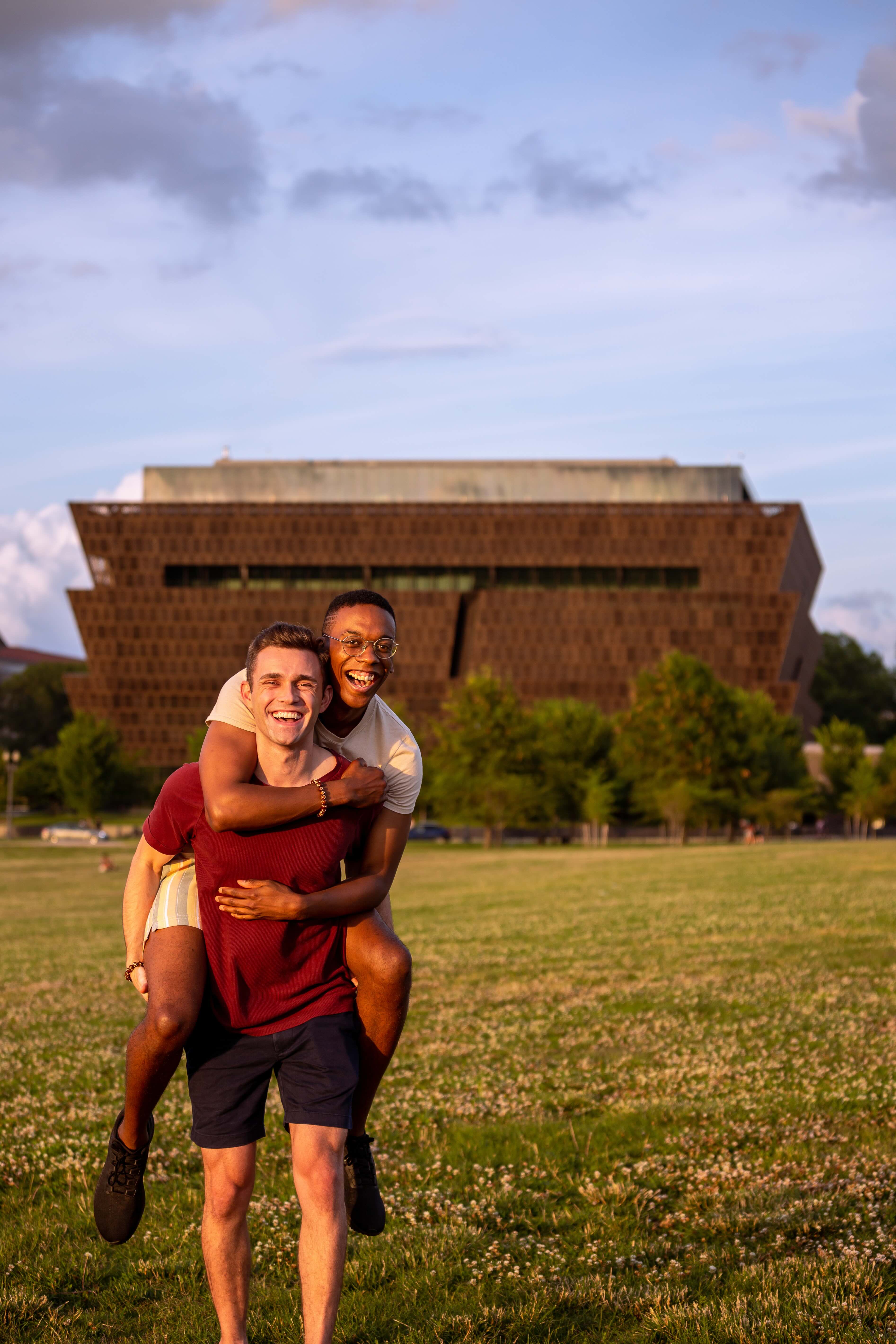
  • happy 30th birthday, Tyler

    A couple Tuesdays ago, August 26th, was my dear friend Tyler’s 30th birthday, and though I’m (characteristically) a little late to post this, it’s a great chance to publicly celebrate him as a person and as my friend. So without further ado, here are some of the reasons I love and celebrate Tyler:

    1. Tyler and I have had a storied and many-chaptered friendship, and through it all I’ve found him to be the person in my life most deeply committed to their friends and friendships. And because of this, I think I’ve similarly become someone who deeply commits to and loves my friends (or at least tries hard to!).
    2. Tyler and I share several niche life experiences that make him easy and familiar to relate to and make me feel seen in specific ways that can be hard for others to understand.
    3. Tyler is a man of many diverse and niche interests. We’ve bonded (and occasionally quibbled) over things as wide-ranging as:
      • food and cooking—how to make a truly spectacular grilled cheese sandwich, or a delightful goat cheese hors d’oeuvre, or why sometimes Thanksgiving casseroles slap and aren’t just a white person ruining an already perfect Thanksgiving dish (though there are times when it is that, to be sure);
      • lots and lots of music, both as a listener and creator—including a quibble over what octave Bruce Springsteen is actually singing in at 3:41 of Born in the U.S.A. (you be the judge);
      • hand puppets;
      • drum corps, and why a certain drum corps is so impressive;
      • films, especially those of Terrence Malick;
      • the book of Leviticus (the man has some points!);
      • the pronunciation of certain words (a good deal of quibbling here, on which I’ve usually been wrong);
      • the meanings of certain words of which I was confident and also, it turns out, wrong.
    4. Among his many loves is Black gospel music (there is evidently White gospel music—not that), which, on account of his infectious love for it, I have also fallen madly in love with. This isn’t hard to do with something Tyler loves, because his love for things is not just personal, but usually eminently sensible. One of his greatest contributions in the realm of gospel music is his iconic Spotify playlist entitled Prepare Ye the Way of the Bops, a collection of gospel bops which as of writing has 48 saves on Spotify (no small feat!).
    5. Tyler is a prolific—and often hilarious—storyteller. His ability to draw a crowd and spellbind a room is uncanny, and only outdone by the actual story he’s telling.
    6. Tyler is brilliant, and he frequently uses his brilliance to think deeply about all manner of things in his friends’ lives and his own life, all in an effort to help people live well.
    7. Tyler overflows with love, compassion, and curiosity toward others, often expressed via his deeply thoughtful, curious, and attentive questions in a conversation.
    8. Relatedly, Tyler is perhaps the most thoughtful and attentive listener I know.
    9. Tyler is a patient and long-suffering person.
    10. Tyler might keep in regular contact with more people than anyone in the world.
    11. Tyler is someone who more than anything else loves Jesus and perpetually wants to love him more, and has oriented his whole life toward that end.
    12. Tyler is an inspiring leader and has the ability to stir people’s hearts and rouse them to action.
    13. Tyler is humble and would probably never volunteer certain impressive or credential-building or ego-boosting information about himself, like the fact that a prominent and world-renowned Bible scholar (I won’t name-drop, but you’ve heard of him) once asked Tyler in a conversation which seminary/divinity school he’d attended (Tyler has not in fact attended seminary or divinity school—see aforementioned brilliance and thoughtfulness).
    14. Relatedly, Tyler is very thoughtfully and earnestly doing some of the critically important practical theological work on Side B—and doing it well I might add, and as a layperson no less. He’s now been on one of the primary podcasts in this space, New Kinship, two (and soon to be three) times, and he just co-led a breakout session at Revoice 2025 with Revoice founder and president Nate Collins entitled Sacred Integration: A Holistic Vision for Sexual Minorities.
    15. Tyler is a tremendously fun person to spend time with.
    16. Finally (though I could certainly say more, but this post is already nearly two weeks late), Tyler loves art, especially films and music, and has introduced me (and I can only assume many others) to truly countless films, filmmakers, songs, albums, and artists. Because of this, and in appreciation for how much music has played a role in our friendship, and out of gratitude for this particular part of who Tyler is, I offer in closing this birthday gift to him of a celebratory playlist:


  • recent inputs

    My contributions to a fall feature of what my colleagues and I have been reading, watching, and listening to:

    Those who know me well know I’m usually reading many different books at once (almost entirely nonfiction) and also usually never finishing any of them. That’s still the case, but lately I’ve been working on sticking with a few at a time and seeing them through before moving on to any others (wish me luck!). In that vein, I’ve returned to finish the back half of Dallas Willard’s The Divine Conspiracy, which I first started reading a few years ago and which quickly revolutionized my conception of what being a Christian actually is. I’d argue Willard—a Baylor alum!—is a must-read for modern American Christians. I’ve also been appreciating Discerning Vocations to Marriage, Celibacy and Singlehood, which offers a framework for and tremendously practical insights into the discernment of marriage, celibacy, and what the authors call “singlehood.” As someone practicing and discerning celibacy, I’m always grateful for thoughtful resources to aid me in that journey. I’m still early into Against Purity, which argues for contamination as a useful starting point and against purity as the ideal endpoint in our quest to live ethical lives, but I’m intrigued by what I’ve read so far. And finally, to try to balance out all this heady, “serious” reading, I’m slowly making my way through Victor Hugo’s Les Miserables, which never fails to elicit in me awe and wonder at the beauty of his characters and sentences.
    In terms of viewing, I also delighted in the final season of The Bear, which was as much about chosen family and the bonds we form with them as it was about bio-family and the bonds we’re born with. I was moved to tears on several occasions, and I thought this season brought the show to a wonderful and endearing close while also leaving it somewhat open-ended and up for speculation, as I think a well-done finale should. Jamie Lee Curtis probably deserves another Emmy for her performance. And speaking of the Emmys, I was thrilled to see The Penguin receive 24 nominations. I simply could not shut up about this show last fall when it was released, and I’m glad to see it getting the recognition it deserves. The writing, directing, acting, and prosthetics(!)—all nominated—were masterful. It’s admittedly a dark show and not for everyone, but it’s a haunting and gripping—and timely—exploration of ambition, power, and violence and the people who wield them.
    Finally, it was a summer of music for me, as I took a long, long road trip out west to Seattle in late June and had a lot of listening time. I made it through most of Jacob Collier’s discography (I was mostly familiar with his recent releases); In My Room, his debut album, was a standout. I also enjoyed James Taylor’s two Greatest Hits albums, the beautiful Nina Simone & Piano album, and Roberta Flack’s Quiet Fire, the latter of which I bought on vinyl from a small trading post in Ouray, Colorado during my drive. In addition to music, driving was a great chance to listen to the audiobook of Steinbeck’s Travels with Charley: In Search of America, which is an absolute delight and best listened to while driving on the open road. All in all, a summer well spent appreciating good media and art!


  • Note: Only after writing the below did I remember that I’d previously written a similar (and more polished) reflection years ago, which I had never posted anywhere but have now published to this blog, dated for its completion. But given I wrote that piece over two years ago and my thoughts below are more specific, I thought I’d keep both.

    One of the things that was transformational for me in my journey of spirituality as a Christian was realizing that the environment and faith tradition I grew up in was not in fact the only Christian tradition, nor the only real Christian tradition, but was actually one tradition or expression or “movement” among very, very many. Thumbing through the table of contents of Richard Foster and James Bryan Smith’s Devotional Classics and seeing their list of different historical Christian streams—”the Contemplative tradition,” “the Evangelical tradition,” “the Holiness tradition,” etc.—remains a key memory of mine, a point where I could succinctly say for one of the first times, “Ah—that one. That’s the tradition I grew up in.”

    I’m sure any expression of Christianity that has a particularly unyielding superiority complex is likely to create some baggage for its adherents, but I think Reformed Christianity, and specifically the version of it I grew up in from middle school through high school and college, creates some unique baggage, which I’ve been slowly unpacking over the years.

    To me, a primary fault of this particular stream of Christianity is its unwavering and often obstinate belief in its own correctness, particularly over against other Christians who have arrived at different interpretations of things. I grew up in a church where it was more or less implied that real Christians went to our church (or a church like it, if they lived elsewhere in the state, country, or world), and those who didn’t probably had “questionable theology.” As an impressionable teenager who was already inclined to have a superiority complex over other people in other ways, I adopted this mindset naturally and without much thought. As a result, I walked around with a spiritual hubris and conviction of my own rightness that was remarkable for someone who was not yet a legal adult. It was only years later that I learned that many of those theological positions I had been taught as “right doctrine” were in fact one view or interpretation or perspective or theory among—often—a debated many, and that a number of them were also different from what the broader Christian Church had taught for most of its history. Seeing some of the rigorous debates about these topics among brilliant and respected scholars across Christian traditions, and seeing my own church tradition and upbringing in this context, helped me (slowly) begin to realize that, intentionally or not, I hadn’t been told the whole truth about Christianity growing up. And now that I was discovering more of it, I began to expand my definition of orthodoxy to be much more historical, much more ecumenical, and much less rigid and self-assured (or, in a word, less dogmatic).

    A second major fault of this tradition I grew up in is its strong emphasis on sin—specifically, how bad sin is, how bad being a sinner is, and the importance of not sinning and instead engaging in right behavior, or being holy. This focus on (individual) sin was in actuality a fixation and overemphasis on it that created what Dallas Willard called a “gospel of sin management,” whereby the Christian life is reduced down to the management of bad behaviors and robbed of the magnitude, mystery, and life that Jesus himself proclaimed.¹ In hindsight, much of my Christian practice in adolescence, influenced heavily by the church I grew up in, was alarmingly similar to that of the first-century Pharisees who were concerned primarily with outward behavior and religiosity, and whom Jesus rebuked sternly for that very reason. Like them, I was fixated on identifying right and wrong doctrine and right and wrong behavior, and I harshly judged those I deemed to be wrong (at least internally, if not externally). I imagine for those outside my particular theological camp I was not a particularly loving person, and I didn’t approach them or their beliefs with curiosity or openness, but with skepticism and an assumption of their incorrectness and inferiority.

    This is all to say, two key points in my growth and maturity as a follower of Jesus were realizing that my Christian background and upbringing were a Christian tradition and not the Christian tradition and, in comparing that tradition to others, seeing some of its overemphases and errors and correcting for them as I determined appropriate.


    ¹See Dallas Willard’s The Divine Conspiracy, particularly Chapter 2, in which he examines gospels of sin management on both the theological left and right. Regarding the right (since it is the tradition I grew up in and am critiquing here), he says, “When all is said and done, ‘the gospel’ for [Charles] Ryrie, [John] MacArthur, and others on the theological right is that Christ made ‘the arrangement’ that can get us into heaven. In the Gospels, by contrast, ‘the gospel’ is the good news of the presence and availability of life in the kingdom, now and forever, through reliance on Jesus the Anointed.”


  • At some point recently I read an edition of Frank Bruni’s newsletter over at The New York Times and discovered his delightful little section called “For the Love of Sentences,” where he features the best sentences of the week as submitted by him and his readers.

    A little more recently, I came across this sentence, also from the Times, that I thought was eminently qualified:

    So Kevin kissed me on Monday and found out he had colon cancer on Friday, and we never talked about the kiss.

    I also thought this was lovely:

    There was a moment early on in our relationship when Kevin visited me in New York. He woke up one morning with the light from my bedroom window shining in his eyes, making them crinkle, and reached out his shaky hands to grab my face. He looked like this little old man, and in that moment, I could see our whole story play out.


  • A month or so ago I took a weekend away to do a solo spiritual retreat, which I’ve done a few times now and have always benefitted greatly from. I’m hoping to do them quarterly going forward.

    As I reflected on some things in my life, I decided I want to spend drastically less time on my phone. Two ways I thought of to accomplish that included checking my phone only three times a day at specific times (and only spending 20-30 minutes on it when I did) and otherwise being on Do Not Disturb, and disabling notifications for all news apps and creating a recurring task for myself to read the news a few times each week.

    One thought I had as I started adjusting to my lighter diet of headlines and articles was that there can be a sort of meaninglessness to our consumption or intake of news. As some have already said long before me, it does feel like we as humans aren’t quite meant to have access to as much information as we now have access to. I’m inclined to believe we’re made for more of the flesh-and-blood stuff of life, particularly embodied relationships with other people, and reading the news can often draw us away from those relationships in favor of an attractive alternative that really doesn’t accomplish much. By that I mean, if I read the news to be informed, what am I actually accomplishing in or contributing to the world based on that newfound knowledge and information? I fear that often my motivation has simply been a desire to appear smart to other people.

    Simply put, maybe I ought to read the news less if my only reason for doing so is to chime in to a conversation with, “oh, I heard about that……pity,” make no other remote contribution to the topic, and return to my quietude pleased with myself that I might now appear more relevant, aware, and in-the-know—all while accomplishing nothing beyond my own self-aggrandizement.

    The monks and nuns have probably influenced me in my thinking here, but it seems like a far better practice to read the news, pray for the people and communities affected by what I’ve just read, check in with any people affected by it with whom I have a relationship, and perhaps even consciously decide not to say anything about the topic even if it does come up in conversation.


  • I am undone by Kirk Franklin’s Father’s Day video. So much to sit with and process, but it feels increasingly clear to me that whatever our experience was growing up—whether adopted or not, for instance—we are all so deeply in need of healing in so many different ways. I’m hopeful that Kirk bearing witness to his own experience in such a public way will invite all of us to consider where we too might need to be healed and reconciled.


  • A threefold pairing I’ve enjoyed in recent weeks:

    1. The Revoice conference in St. Louis last month.
    2. Watching the entire Lord of the Rings trilogy (extended editions) for what I think was only my first time as an adult.
    3. A devotional I read the other morning from Henri Nouwen’s Bread for the Journey (which is so good!), quoted in full below.

    June 29

    Taking Up Our Crosses

    Jesus says, “If anyone wants to be a follower of mine, let him…take up his cross and follow me” (Matthew 16:24). He does not say “Make a cross” or “Look for a cross.” Each of us has a cross to carry. There is no need to make one or look for one. The cross we have is hard enough for us! But are we willing to take it up, to accept it as our cross?
    Maybe we can’t study, maybe we are handicapped, maybe we suffer from depression, maybe we experience conflict in our families, maybe we are victims of violence or abuse. We didn’t choose any of it, but these things are our crosses. We can ignore them, reject them, refuse them, or hate them. But we can also take up these crosses and follow Jesus with them.

    I’ve been thinking about the idea, present in all three of these, of committing to and persevering in a difficult journey or quest. Committing to live one’s life as a celibate gay or queer person who holds to the historical Biblical interpretation of human sexuality, for example, is a considerably difficult quest to embark on. As I payed particularly close attention to Frodo’s character in my viewing of the Lord of the Rings, I found myself identifying with his burden in new ways. Lines like, “[the ring] is my burden, and no one else can bear it” spoke to me of the isolating nature of being on a journey no one else can complete for you—or to use Nouwen’s language, of bearing a cross that is uniquely yours to bear, not anyone else’s.

    It’s not to say other people don’t have their crosses and their difficult quests in life, of course, but it is to say this is (one of) mine. And I used to think of bearing my cross as a “same-sex attracted Christian” in a different way, in a much more expulsive and self-resenting way. But in time I’ve come to see that as much as my bisexuality presents me with some significant difficulties and challenges in life, it also has its gifts and its graces, which I can receive if I open myself to the possibility of their existence.


  • the Messiah has a name

    I just started listening to the Bible Project’s recent podcast series on anointing, and the first episode’s title and content were a reminder of a curious thing I started noticing only when I started growing away from the faith tradition I grew up in: a lot of Christians refer to Jesus as “Christ” almost exclusively, despite the fact that “Christ” is not a name but a title. I remember phrases like “my relationship with Christ” being used frequently in my church community growing up, and I struggle to remember the contexts in which people would use Jesus’ actual name. The same is true for “Lord”—another title for Jesus—which people may have used more frequently than “Christ” in fact. “The Lord’s been good;” “I love the Lord.”

    This isn’t to say using a title to refer to Jesus is in any way wrong. I just came to find it interesting that, say, 90% of the time these Christians referred to Jesus, they used titles. As I reflected on how that particular idiosyncrasy shaped my experience of faith, I felt like it actually served to distance me from the person of Jesus and the intimate relationship I’m able to have with him. So for me the pendulum has swung, and these days I nearly always refer to Jesus by the name God told Mary to call him, a name that means “Yahweh saves”—or, as the First Nations Version translates it, “Creator Sets Free.”


  • Two quotes from a thoughtful Maundy Thursday devotional by Mari Graham Evans:

    Modern property ownership concepts would have been totally foreign to ancient Hawaiians. Land could not be bought or sold by mere men. The land was beyond men. How do you purchase or sell something that gave you life? 

    This Maundy Thursday, I encourage you to identify ways to be vulnerable, uncomfortable, and maybe a little grimy in service to others.


  • Dorothy Day:

    God is a sensitive lover. God will not force you to choose him.


  • The Atlantic:

    As I’ve talked with astronomers about what Webb has found so far, one word keeps coming up: shouldn’t. Galaxies shouldn’t be this way; the cosmic dawn shouldn’t be that way. I find these shouldn’ts delightful. They hint at the well-intentioned hubris of humans, especially the most curious ones, those who wish to determine exactly how something works and why. But of course the universe says, speaking to us by way of a giant telescope floating a million miles from Earth, This is how it is. This is, apparently, how it has always been. We’re just discovering the wonder of it now.


  • 🌈

    Today is National Coming Out Day, which feels like as good a day as ever to share more publicly that I’m bisexual. Though this has been my experience for as long as I can remember, I was only able to name it as such midway through college. And as someone who’s deeply committed to following Jesus for the rest of my life, I’ve had to very seriously reconsider what he actually taught about sexuality and marriage in light of the forcefulness of my own experience.

    As I’ve laboriously considered Jesus’s teaching in recent years, along with that of the rest of the Bible, I’ve come to the firm conclusion that the historic Christian sexual ethic, which defines marriage as a monogamous union of two people of the opposite sex (i.e., two people who are sexually different), still represents the most faithful interpretation of Jesus’s teaching on marriage and sexuality. As such, though I experience romantic attraction to both women and men, I have ruled out for myself the possibility of marrying (or dating) a man based on this theological conviction. While some might see this as oppressive or self-hating, I haven’t found it to be; instead, I‘ve found deep meaning, purpose, life, and joy in following this unique call of God on what’s been termed “Side B.” And I’ve learned to rest in the incomparable love of the God who calls me his own, who delights in me, who affirms me, and who sings over me because he just can’t contain all the joy he has for me, his beloved child.

    But despite not being oppressive or hateful, God still calls me to very hard things, and living out my sexuality according to this ethic is indeed a hard thing. For the foreseeable future if not the rest of my life, when I start to develop romantic feelings for a man, I’ve decided I won’t take the next step and ask, “would you want to go on a date sometime?” Because try as I might to convince myself of the truth of the interpretation of Scripture that would allow for such a next step, I still find the alternative interpretation much more compelling. But thankfully, even as God calls me to do hard things like this in my life, he also empowers me to walk them out through his Spirit, which he’s given to me and which lives inside me—really!—giving me supernatural energy and desire to follow him. And at the end of the day, Jesus calls me to lay down my entire life for him, so if he’s not worth surrendering something as massive and central to my experience of life as my sexuality, what is he worth? And if I really believe that Jesus came to bring abundant life for everyone (John 10:10) and that that life is the truest, best, and most beautiful version of life possible for any of us (which I emphatically do believe), then I am compelled to believe that he knows better than me, despite what I feel in my heart and in my body.


    So there you have it: I’m bisexual, with a bit of a clarification. If you’d like to know or learn more about my experience, 1) feel free to ask me (though I can’t promise an answer to everyone or every question)—I’d rather you do that than wonder about or assume something or ask someone else to speak for me; and 2) stay tuned! I plan to write plenty more about this in the future. But for now, in the immortal words of Diana Ross, “I’m coming out!”

    ~MR


  • Toward Ecumenism

    Note: I originally wrote this piece on the date listed, but didn’t publish it on this site until 2025.

    I feel like I’ve spent much of the last three years of my life unlearning many of the things I learned growing up, whether it was things I was taught in church, things I learned by osmosis from my parents and other family members, or things I’d really like to attribute to someone else but in reality I came to believe all by myself.

    The things I learned in church were almost always taught as definitively true, without any mention of alternate Christian viewpoints or perspectives, which functionally left very little room for debate or dissension despite the fact that plenty of it exists between Christian denominations on all sorts of issues. And when I did have questions, I confined my research and exploration for answers to the comfortable safety net of my own Christian tradition. This was partly my own doing and perhaps mostly because of my personality, but it was also partly the result of my coming of age in a church culture where most alternative beliefs were to be viewed with skepticism. My predisposition for wanting to be right was satisfied and reinforced by a Christian denominational culture that held nearly all of its beliefs rigidly. As a result, at 17 and 18 I was as sure-headed a Christian as they come, preaching a gospel that I was largely parroting from the church and denomination I’d come to faith in. It was only much later, when I was 22 and nearing the end of college, that I started to reexamine my affiliation with this denomination and its culture and explore other Christian voices and traditions.

    As I explored, I felt my heart and soul opening up to experience Christianity in a new way, and I saw for the first time how much beauty exists across so many Christian denominations and communities. I felt the heaviness of my rigid beliefs—the burden I’d taken upon myself to always have the “right” theology—begin to lift as I gradually accepted that I didn’t have all the right answers, that the right answers might very well lie within another Christian denomination or expression, and—most importantly—that looking for “right answers” is actually not what following Jesus is fundamentally about in the first place. I came to accept (and am still learning to accept) not knowing everything definitively and holding what I do believe with a loose hand. The reality is, truth exists in plenty of surprising places that I might otherwise be inclined to ignore or push away, but opening myself up to it, listening to it, wrestling with it, and learning or gleaning from it is the path to a fuller and richer experience of following Jesus.

    I’m thankful to be living out a more ecumenical version of my Christian faith now, one marked by humility, grace, beauty, and a realness and intimacy with God that I didn’t experience anywhere near as deeply before. It’s an expression of Christianity that, in hindsight, my denominational upbringing was not conducive to. We kept to our menu of authors and blogs and pastors who aligned with our expression of Christianity (and I fell in line, for my part). Apart from the Holy Spirit working through some very specific people during my senior year of college, I may not have discovered and experienced, for example, the Spirit-filled expressions of charismatic Christians, or the beauty and complexity of contemplative mystics, or the simplicity and order and discipline of monastic life. It’s these Christian expressions (and many others) that have come to deeply shape how I follow Jesus and live in this world as a Christian.

    To the friends and others along the way who have known me, I regret that you may have a certain image of what Christians are like and who Jesus is because of the immature ways I have lived out my faith. My hope and prayer is that the reality of Jesus’s extravagant love for you has won out as the core message of his life and teaching, and that through him you may “have life and have it abundantly” (John 10:10)—not just believing a gospel of sin management, but rather a gospel that calls us as God’s beloved children to make Earth look more like heaven, to proclaim freedom for the oppressed, and to declare the good news of God’s redemption of all things.